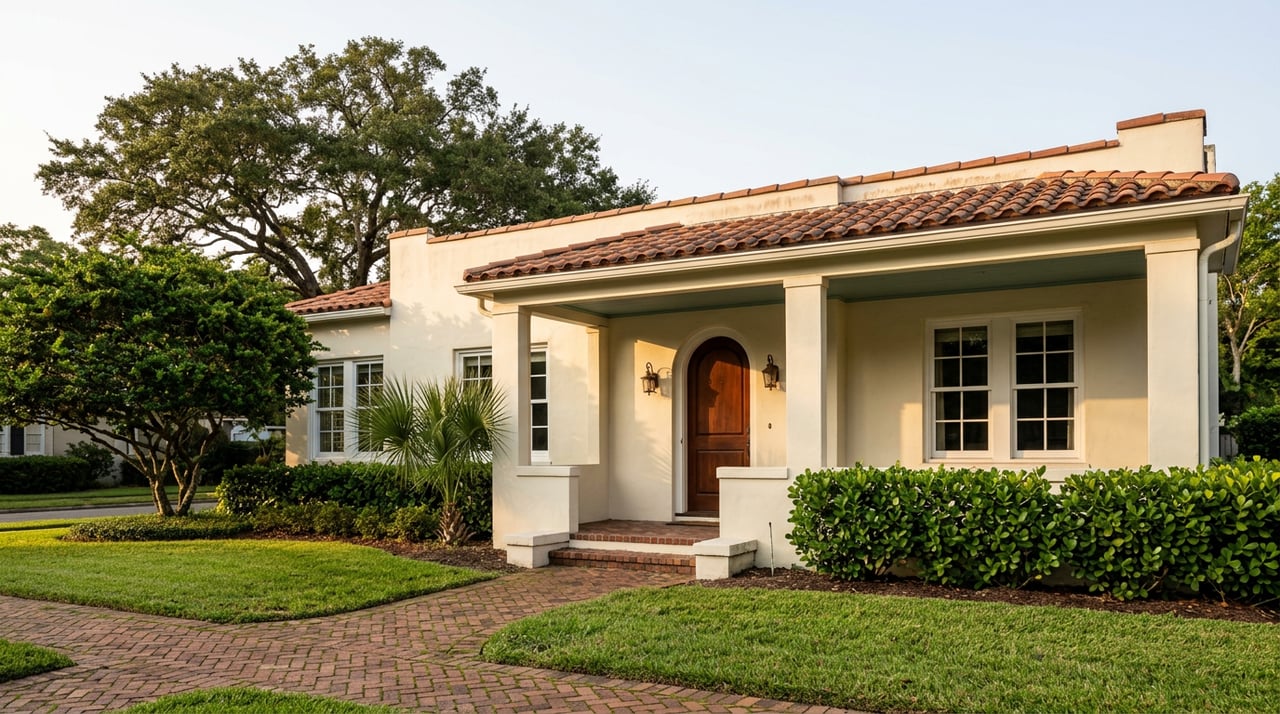
Walk down NE 6th Street in Del-Ida Park on a weekday morning and two Craftsman bungalows sit almost identical on the block: same 1920s roofline, same diagonal street pattern that makes this corner of Delray Beach feel like nowhere else in the city, same Certificate of Appropriateness rules governing anything either owner might want to change on the outside. One of those houses, though, carries a tax bill that is thousands of dollars lighter than the other, and the reason has nothing to do with square footage or lot size. It has to do with a ten-year clock that started running before either current owner ever saw the listing.
That clock is Delray Beach's Historic Property Ad Valorem Tax Exemption, and it is the part of buying or selling in one of the city's five historic districts that almost never comes up before an offer gets written. Everyone asks about the Certificate of Appropriateness, or COA, because it sounds like the obstacle. It is actually the predictable part. The exemption is the variable, and it follows the deed, not the person who earned it.
The Part That's the Same Everywhere
Delray Beach designated its first four historic districts in 1987, then added a fifth, West Settlers, a decade later. Today the city recognizes West Settlers, Old School Square, Del-Ida Park, Nassau Park, and Marina on its Local Register of Historic Places, and every one of them answers to the same review process for exterior work. A property owner in any of the five needs a Certificate of Appropriateness before changing exterior color, replacing a roof, adding onto a structure, or tearing one down. Demolition specifically requires a building permit to be issued for whatever comes next before the demolition itself can happen.
Two of the five districts, Old School Square and Nassau Park, layer on extra scrutiny for fences and walls under the city's land development regulations, meaning a straightforward backyard privacy fence project can pick up a Historic Preservation Board review that a similar fence in, say, Del-Ida Park would not automatically trigger. Interior renovations, by contrast, generally sit outside the review process entirely unless they touch a protected architectural element. That distinction matters for anyone comparing a fixer in one district against a fixer in another, but it is not where the real money sits.
The Part That Changes the Math
The city's Historic Property Ad Valorem Tax Exemption exempts 100 percent of the assessed value added by qualifying rehabilitation work, for up to ten years. The city's own example makes the mechanics concrete:
A property assessed at $100,000 gets $25,000 in qualifying rehabilitation work. That $25,000 in added value is not assessed for tax purposes for ten years.
Here is the detail that turns this from a homeowner incentive into a transaction detail: if the property sells while the exemption is still running, the exemption transfers to the new owner. The clock does not restart and it does not disappear. A buyer closing on a Del-Ida Park bungalow with six years left on an active exemption is buying six years of reduced assessed value along with the house, whether or not anyone mentions it during showings.
That is the whole point of the two bungalows on NE 6th Street. Same COA rules, same architectural review board, same district designation. One seller filed the paperwork for a documented rehabilitation years ago and still has time left on the exemption. The other never applied, or the exemption already expired. From the sidewalk, the houses look the same. On the tax roll, they do not.
Five Districts, One Rulebook, Two Different Incentive Stacks
The COA process is uniform across all five districts. The incentive stack underneath it is not, and that gap is worth knowing before anyone assumes a historic designation means the same thing everywhere in the city.
| District | Era / Designated | Defining Architecture | What Sets It Apart |
|---|---|---|---|
| West Settlers | Settled 1894, designated 1997 | Frame vernacular, shotgun cottages | The city's first African-American settlement, centered on Northwest 5th Avenue |
| Old School Square | Structures 1902 to 1945 | Frame and masonry vernacular, Craftsman bungalows, Banker's Row | Delray's largest district, 176 structures with 101 contributing; also on the National Register |
| Del-Ida Park | Platted 1923, designated 1988 | Mediterranean Revival, Craftsman Bungalow | Diagonal streets and triangular blocks; 151 structures across 58 acres |
| Nassau Park | Platted 1935, designated 1988 | Cape Cod Colonial Revival | Just seventeen cottages across two blocks near the ocean, Delray's first local historic district |
| Marina | Built 1922 to 1943, designated 1988 | Mediterranean, Mission Revival, Streamline Moderne, Art Moderne | The only district also on the National Register of Historic Places, added in 2014 |
That last column matters more than it looks. Only Old School Square and Marina carry National Register status alongside their local designation. That distinction opens the door to a separate federal incentive: a 20 percent tax credit on certified rehabilitation of income-producing historic properties within a nationally listed district, administered under the federal historic rehabilitation program. A duplex or rental property inside Marina or Old School Square can potentially stack that federal credit on top of the city's local exemption. The same duplex in Nassau Park or Del-Ida Park cannot, because those two districts, despite being just as protected locally, never received the national listing.
So the rulebook is identical. The payout is not. A buyer evaluating an income property in Marina is looking at a different incentive picture than a buyer evaluating the same kind of property in Nassau Park, even though both will file the same COA paperwork for exterior changes.
What to Ask Before You Write an Offer
For a buyer looking seriously at a historic-district property in Delray Beach, the questions worth settling early are not about whether the COA process will be a hassle. They are about what has already happened on the property's paperwork trail.
- Is the home individually listed on Delray's Local Register, or is it a contributing structure within one of the five districts? The two carry different review thresholds.
- Has a Certificate of Appropriateness already been filed and approved for any visible work the current owner made? An undocumented exterior change can surface as a compliance question later, even if it looks finished and attractive today.
- Is a Historic Property Ad Valorem Tax Exemption currently active on the property, and if so, how many of the ten years are left? This is a direct line item on the property's tax future, and it is worth asking the seller's agent directly rather than assuming.
- If the property sits in Old School Square or Nassau Park and any fence, wall, or hardscape work is planned, has that specific review requirement been priced into the renovation budget and timeline?
- For income-producing property in Marina or Old School Square, has the federal 20 percent rehabilitation credit been explored, or is it still on the table for future work?
What This Means for a Seller
If a seller in one of these five districts has an active exemption running, that is not paperwork to file away. It is a selling point that should show up in the listing narrative the same way a new roof or updated systems would. A buyer comparing two similar historic homes will weigh a documented, transferable tax exemption differently once they understand what it means for their own holding costs over the next several years.
The same logic runs in reverse for sellers who never filed. If qualifying rehabilitation work happened without ever going through the exemption application, that value is sitting on the table unclaimed. It is worth a conversation with the city's Historic Preservation Division before listing, not after an offer is already in hand and a buyer's agent starts asking questions the seller cannot answer.
FAQ
Does the exemption cover interior renovations? No. The Historic Property Ad Valorem Tax Exemption is tied to visible exterior improvements as part of the qualifying rehabilitation. Interior-only work does not trigger the exemption on its own.
Do all five districts require the same review for a simple exterior repaint? Yes. A Certificate of Appropriateness, along with a Building Materials and Color Sample Form, is required to change exterior color anywhere within a designated historic district or on an individually listed property.
If I buy a home with an active exemption, do I need to do anything to keep it? The exemption transfers with the sale, but confirming the remaining term and any conditions attached to the original approval is worth doing with the city's Historic Preservation Division before closing, so there are no surprises on the next tax bill.
Buying or selling in one of Delray Beach's historic districts comes with real financial detail that a listing photo will never show. If you are weighing a property in Del-Ida Park, Marina, or any of the city's other historic neighborhoods and want to understand what's actually on the tax roll and the compliance record before you make a decision, Michelle Nelson can walk through the specifics with you. Schedule Your Free Consultation to get started.